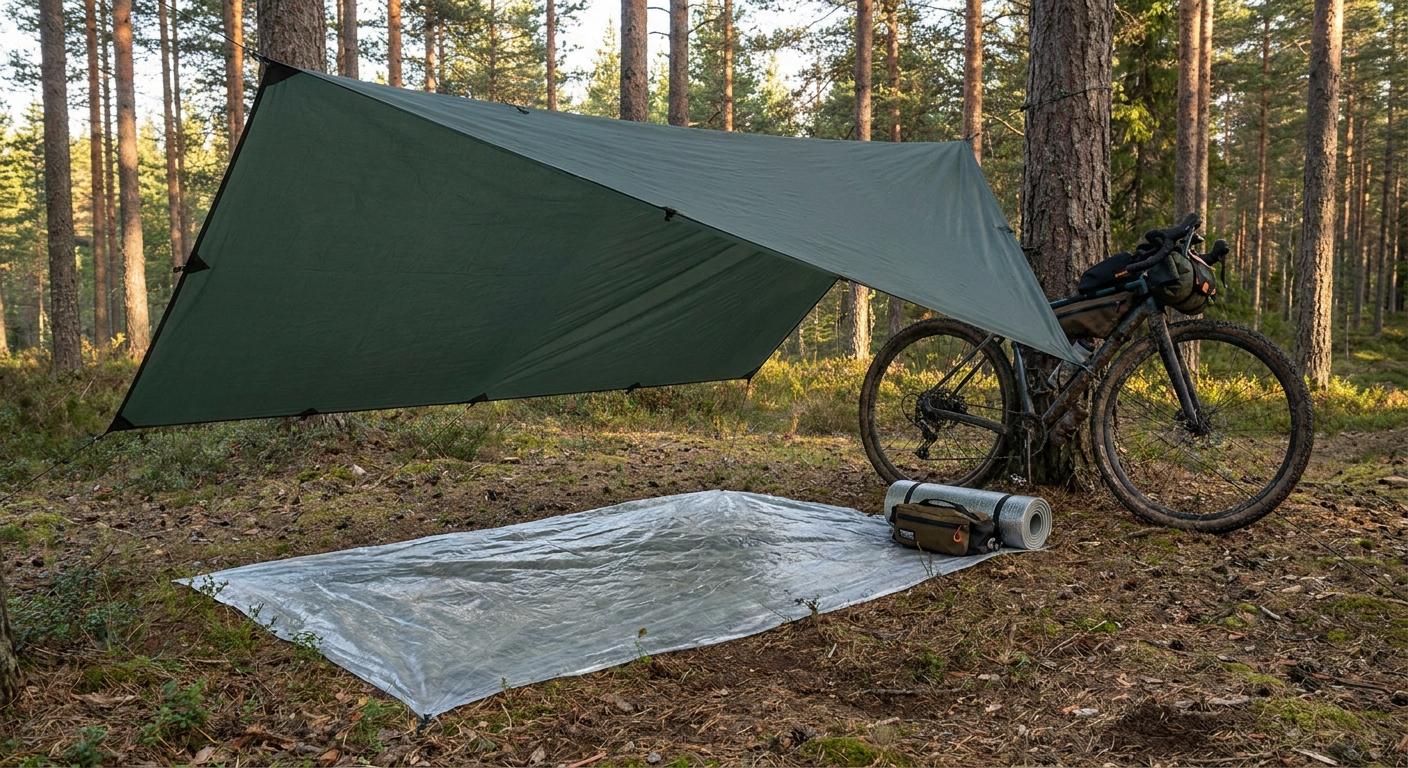
An ultralight groundsheet for tarp camping needs to do three things at once: block ground moisture, survive grit under a bikepacking setup, and add almost nothing to your base weight. In 2026, the material that does this best for most tarp and hammock campers is thin polyolefin, not the Tyvek or Polycro sheets that dominated MYOG forums a few years back.
- A ~18g/m² polyolefin groundsheet for tarp camping beats Tyvek and Polycro on weight in 2026 — buy it for solo tarp and hammock setups.
- Polyolefin skips the seam-sealing step raw Tyvek housewrap needs, cutting pitch time under a tarp by minutes, not hours.
- Cut your groundsheet 5-10cm smaller than your tarp footprint so it sheds rain instead of pooling it under your pad.
- Bikepackers should rank packed size above raw durability — a torn groundsheet is a 2-minute tape patch, a heavy one costs you every mile.
Why This Matters
Most ultralight groundsheets fail one of two ways: they're heavy enough to notice in a 700g bikepacking kit, or they're so thin they abrade through in one season of gravel and pine duff. Polyolefin at roughly 18 grams per square meter sits in the narrow band that survives both problems — it's lighter than most Tyvek cuts and doesn't stiffen into a crinkling, noisy sheet the way housewrap does in cold weather.
For tarp camping specifically, the groundsheet is doing the job a tent floor would otherwise do. Get the material or the cut wrong and you're sleeping on damp ground by 2 a.m., which is a worse failure than a few extra grams ever was.
Who This Is For
This guide is for tarp campers, hammock-and-tarp hybrids, and bikepackers who already run a quilt-and-tarp system or are building one, plus MYOG builders sourcing raw material to cut their own footprint. If you're still carrying a full double-wall tent, a groundsheet upgrade won't move your base weight enough to matter — this is a decision for people who've already cut everywhere else.
What to Look For in an Ultralight Groundsheet for Tarp Camping
Weight per square meter
This is the number that actually separates categories of material, not brand marketing. Polyolefin sheets running around 18g/m² sit meaningfully lighter than most off-the-shelf Tyvek cuts, and every gram here compounds across a multi-day trip where you're also carrying food and water.
Waterproofing without seam sealing
A groundsheet that needs seam tape defeats part of the point — you're adding weight and prep time back in. Polyolefin sheets are waterproof as a single unseamed piece, which matters most for tarp campers who don't have a bathtub floor backing them up.
Cut size and shape for your shelter
A groundsheet cut to match your tarp's exact footprint pools rainwater under your pad during a real storm. Cutting it 5-10cm smaller than the tarp's drip line on each side is the standard fix, and it matters more for tarp setups than for tents because there's no floor perimeter doing the work for you.
Noise and stiffness in cold weather
Raw Tyvek housewrap gets loud and stiff below freezing, which is a real problem for anyone sleeping close to the ground on a hammock-and-tarp setup where every crinkle is audible. Polyolefin stays quieter and more flexible in the cold, which is one reason it's replaced Tyvek in a lot of 2026 MYOG builds.
Puncture resistance vs. weight tradeoff
Thinner isn't automatically better. A 2026 bikepacking route with scree, thorny scrub, or hardpack gravel will find the weak point in any ultralight material faster than a manicured trail campsite will. Match the material weight to your actual terrain, not your lightest-possible ideal.
Tie-out points and grommets
If you're pitching the groundsheet as part of the shelter system rather than just laying it flat, grommets or reinforced tie-out corners save you from field-rigging a fix with cord and duct tape at 9 p.m.
Top Picks by Use Case
The solo tarp camper — Buy. A single-person cut around 18g/m² polyolestin from Xfoil covers a standard sleeping pad footprint with margin to spare and packs down small enough to disappear in a stuff sack pocket. This is the default recommendation for anyone running a solo tarp-and-quilt system in 2026.
The bikepacker with a tight frame bag — Buy. Packed size beats raw durability here because you're optimizing for volume, not just weight. A thin polyolefin sheet folds flatter than Tyvek and rolls smaller than PVC, which is the deciding factor when your frame bag is already full of tools and a stove.
The MYOG builder cutting custom footprints — Consider. Raw polyolefin sheeting is easy to cut and doesn't fray at the edge the way woven fabrics do, but you're on your own for reinforcing corners and tie-outs. Fine for someone comfortable with a rotary cutter and grommet kit, not for a first MYOG project.
The four-season or scree-heavy route camper — Consider. Standard ultralight polyolefin will survive most trail conditions, but sustained abrasion on sharp scree or repeated freeze-thaw pitching wears any sub-20g/m² material faster. Double it up or accept a shorter usable life for that specific trip type.
The group shelter user pitching a shared tarp — Skip on single-person cuts. A groundsheet sized for one sleeping pad won't cover a shared tarp footprint, and seaming two together adds weight and a leak point exactly where you don't want one.
Shop ultralight tarp groundsheets
Polyolefin groundsheets built for tarp camping and bikepacking, in stock for 2026.
What to Avoid
- Blue poly tarps from the hardware store. They're waterproof, but the material is often several times heavier than a purpose-cut ultralight groundsheet and stiffens badly in cold weather.
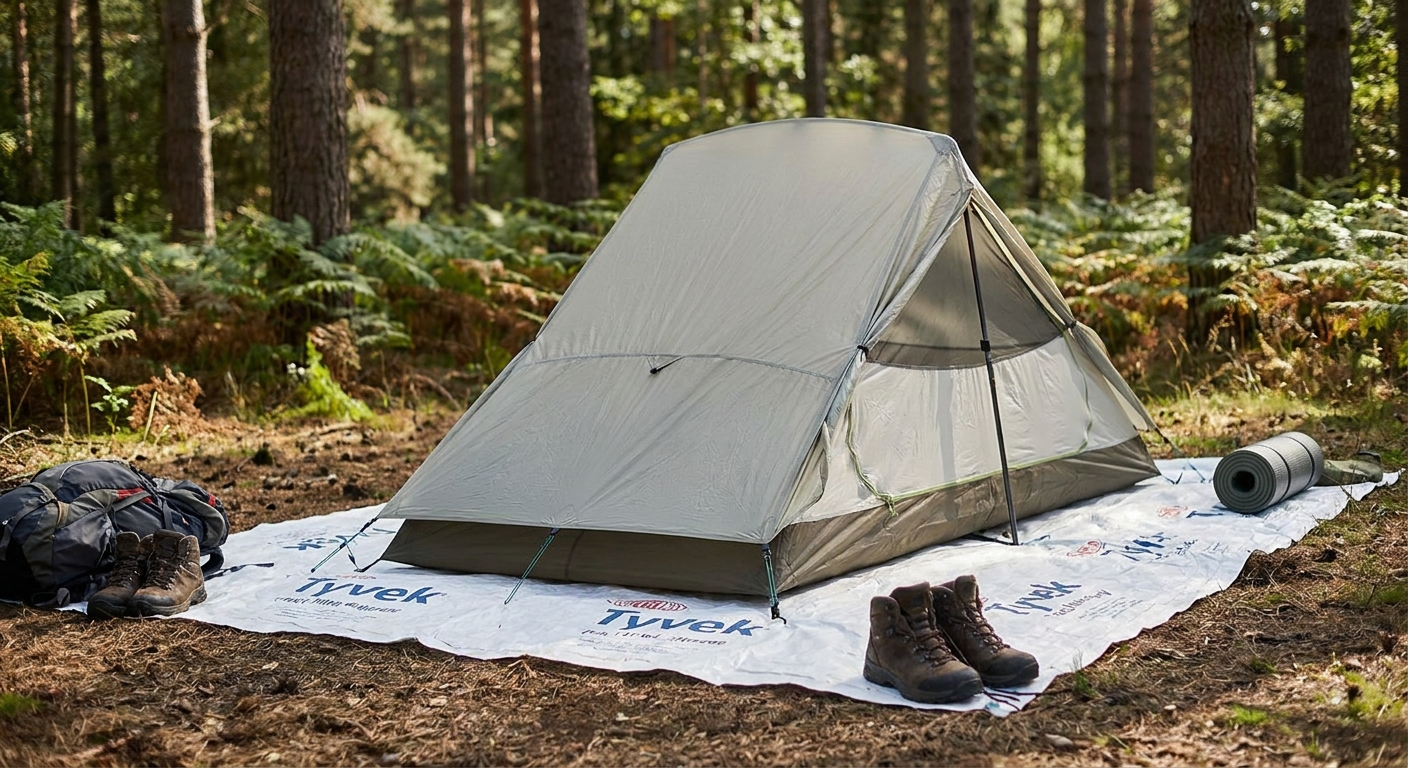
- Raw Tyvek housewrap without seam prep. It's cheap and available, but untreated housewrap needs washing and seam sealing before it performs like a real groundsheet, and it stays noisy underfoot.
- PVC-coated groundsheets marketed as "heavy duty." Durability sounds like a win until you weigh one against a polyolefin sheet — PVC groundsheets routinely run multiples heavier for the same footprint, which defeats the point of an ultralight kit.
Verdict Comparison
| Criteria | Polyolefin (Xfoil) | Tyvek | Polycro | Blue Poly Tarp |
|---|---|---|---|---|
| Weight class | Lightest of the group | Light, but heavier than polyolefin | Very light, more fragile | Heaviest by far |
| Seam sealing needed | No | Often, for raw housewrap | No | No |
| Cold-weather noise | Low | High, stiffens and crinkles | Low | Moderate |
| Puncture resistance | Moderate | Moderate to good | Low | High |
| Best for | Tarp camping, bikepacking | Budget MYOG builds | Ultra-minimalist solo | Car camping, not backpacking |
FAQ
What's the best ultralight groundsheet for tarp camping in 2026?
A polyolefin groundsheet around 18g/m² is the best pick for most tarp campers in 2026 because it's lighter than Tyvek and doesn't need seam sealing. It's the right call for solo tarp-and-quilt setups and most bikepacking kits.
Is polyolefin better than Tyvek for a groundsheet?
Polyolefin is lighter and quieter in cold weather than raw Tyvek housewrap, and it doesn't require seam sealing before use. Tyvek remains a budget option for MYOG builders willing to prep the material themselves.
How much does an ultralight groundsheet weigh?
Ultralight polyolefin groundsheets run around 18 grams per square meter, well under most Tyvek or PVC alternatives. The exact weight depends on the cut size for your specific tarp or sleeping pad footprint.
Do I need a groundsheet if I already have a tarp?
Yes, a tarp has no floor, so a separate groundsheet is what keeps ground moisture and abrasion off your sleeping pad. This matters more for tarp camping than for a double-wall tent with a built-in bathtub floor.
What size should my groundsheet be for tarp camping?
Cut the groundsheet 5-10cm smaller than your tarp's footprint on each side so rain sheds off the tarp edge instead of pooling on the groundsheet. Matching it exactly to the tarp size is a common mistake that causes puddling in a real storm.
Is Polycro or polyolefin better for bikepacking?
Polyolefin generally holds up better under repeated packing and abrasion than Polycro, which is thinner and more prone to tearing. Polycro can still work for ultra-minimalist solo trips where packed size matters more than durability.
Can I use a groundsheet without a tarp?
You can use it under a hammock, bivy, or as a sit pad, but it's not a standalone shelter on its own. Most buyers in 2026 pair it with a tarp or hammock system rather than using it alone.
One Last Thing
The detail most buyers skip is cutting the groundsheet slightly undersized for their actual tarp pitch, not the tarp's stated dimensions on the label. A tarp pitched low and taut in wind covers a smaller ground footprint than its flat spec sheet suggests, so a groundsheet cut to the label size ends up too big and catches wind-driven rain at the edges. Measure your actual pitch once, then cut to that number.
Heading into another season of tarp camping and bikepacking in 2026, the material choice matters less than most gear threads suggest — polyolefin at 18g/m² covers the vast majority of use cases, and the real variable is whether you cut and pitch it correctly.